
Case Study Lucian Rosata: Full Renovation of a Traditional Bruges Townhouse Into a High-End Residential Interior

Lucian Rosata
Chief Executive
Expertise
With over 17 years of experience across the Belgian, French, and Romanian markets, I deliver professional interior renovations built on technical precision and proven international standards. My approach focuses on high-performance reconstruction, ensuring every project is engineered for long-term durability.
Direct Value
By working with me, you eliminate the middleman and avoid paying extra for agency overhead. This direct-to-client model ensures a superior price-quality ratio, where your entire budget is invested directly into expert craftsmanship and premium materials rather than unnecessary commissions.
Performance
I transform dated spaces into modern environments through a rigorous four-step technical process. From advanced waterproofing to complete electrical and plumbing overhauls, I provide end-to-end renovation services that prioritize structural integrity and contemporary design.
The Context
The property was a traditional residential building typical of Bruges architecture, featuring an exposed timber roof structure with characteristic pitched trusses.
At the start of the project, the interior was completely stripped and non-functional: bare brick walls, raw concrete subfloors, and no usable electrical, plumbing, or heating infrastructure in place.
The entire interior had to be rebuilt from scratch, while respecting the architectural identity of the original structure and the heritage context of the city.
The objective was to transform a fully uninhabitable shell into a modern, high-end residential interior, delivering contemporary living standards without erasing the historic character of the building.


The Challenge
The main challenge was executing a complete interior reconstruction inside a traditional Bruges property, where every modern technical system had to be integrated invisibly while the original architectural features were preserved and enhanced.
Key obstacles included:
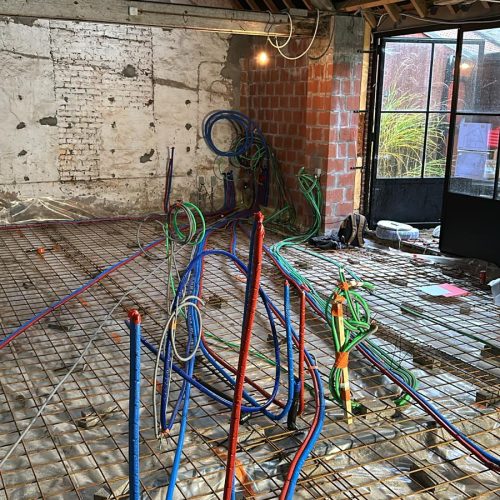
- Raw subfloors required full preparation and a new structural concrete slab with embedded underfloor heating before any finishing could begin.
- All electrical, plumbing, and heating circuits had to be designed and laid within the new slab, with no possibility of correction once the concrete was poured.
- New internal partitions had to be constructed using lightweight aerated block and drywall systems, carefully coordinated with the irregular geometry of the existing timber roof trusses.
- The pitched ceiling surface (multi-angled and interrupted by exposed beams) required a custom approach for plastering and painting to achieve a consistent finish throughout.
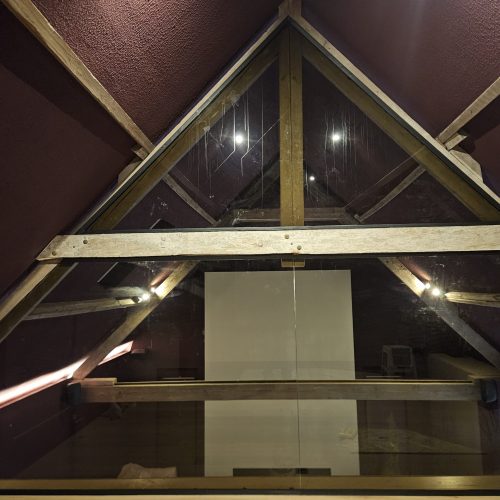
- A mezzanine level with a glass balustrade had to be integrated structurally without compromising the visual openness of the double-height volume.
- Decorative microcement was applied across floors, walls, stair surfaces, and built-in elements, requiring controlled multi-layer application to avoid cracking or colour inconsistency.
- All finishes had to read as a single cohesive interior despite spanning multiple trades and material systems.
The Approach and Solution
Step 1: Structural Slab and Underfloor Infrastructure
The existing subfloor was fully prepared for a new reinforced concrete slab. A steel mesh reinforcement grid was laid across the entire ground floor, and all underfloor heating loops, water supply lines, drainage pipes, and electrical conduits were positioned and fixed within the slab before pouring. All circuits were pressure-tested and verified before concrete was cast. This phase locked in the entire technical infrastructure of the building with no margin for error.
Step 2: Internal Partitions and Structural Integration
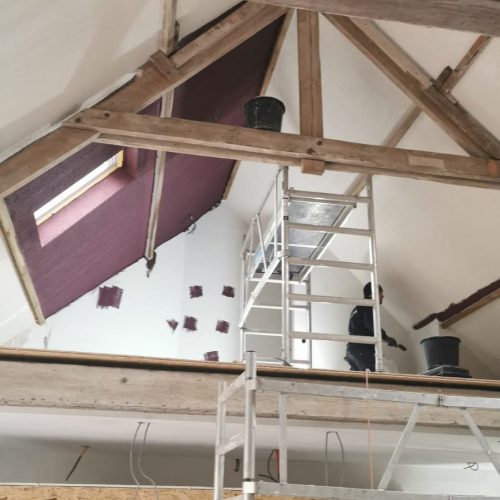
New internal walls were constructed using aerated concrete block and metal-frame drywall systems, subdividing the interior volume into functional living zones while respecting the geometry of the existing roof structure. Openings for doors, the staircase, and the mezzanine were coordinated with the timber truss positions. A glass balustrade system was installed at mezzanine level to preserve sightlines across the full height of the space.
Step 3: Microcement Floors, Walls, and Surfaces
Microcement was applied as the primary finish across all ground floor surfaces, corridor walls, staircase treads and risers, the fireplace surround, and the kitchen island structure. Each application followed a multi-stage process: substrate priming, base coat, fibre reinforcement mesh, finish coat, and final protective sealing. Colour consistency was maintained across all elements to unify the interior visually, resulting in a seamless, jointless surface throughout the living area.
Step 4: Ceiling, Beam, and Wall Finishing
The pitched ceiling surfaces between the exposed timber trusses were plastered, primed, and painted in a deep bordeaux tone, chosen to contrast with the raw grey timber and amplify the dramatic volume of the roof. White plaster zones at lower wall levels create a tonal transition between the dark ceiling and the neutral microcement floor. All beam faces were cleaned and left exposed as a deliberate architectural feature.
Step 5: Final Installations and Completion
Hardwood flooring was installed on the mezzanine level. The linear fireplace was set into its microcement surround and commissioned. Bathroom and shower installations were completed with black matt fixtures. Recessed lighting was installed throughout, with additional accent lighting integrated at beam level and along corridor baseboards to reinforce the atmospheric quality of the finished interior.
The Result






Consistency in Every Square Meter
This project is just one example of how we challenge the Belgian renovation market. Explore our other case studies to see how we balance high-end technical execution with cost-effective strategies, delivering premium results across various property types without the standard industry premium.


Newsletter Updates
Enter your email address below to subscribe to our tasty newsletter